Velvet Horns: Identity‑Shift Vision Boards
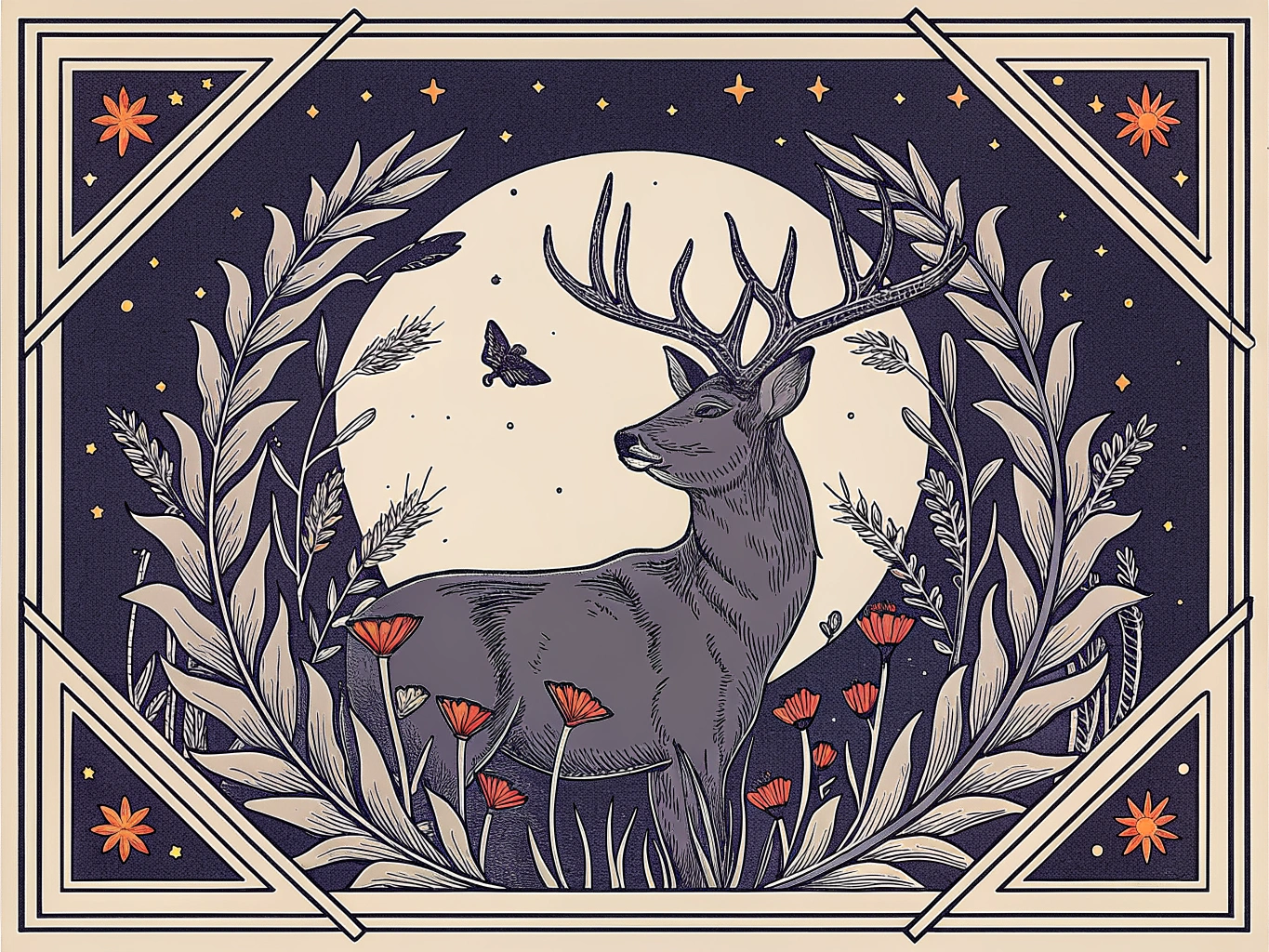
The Buck Moon rises July 29, 2026.
Author: Megan Williams
The Buck Moon
This Buck Moon in Aquarius 2026 is a Full Moon often associated with growth and release, and here I’m looking at Buck Moon meaning through the lens of folk magic, velvet horns, and vision boards for manifestation and identity‑shift.
The Buck Moon reaches its peak on July 29, 2026, a Full Moon traditionally linked not with “attracting more,” but with releasing, clarifying, and levelling up. Astrologers describe it as a moment to see what has outgrown you, especially around freedom, community, and the future you’re building with others.
Because this Buck Moon falls in Aquarius, the emphasis shifts toward independence, the collective, innovation, and honest truth-telling. This isn’t the time to launch brand‑new manifestation work so much as to notice which habits, roles, and stories no longer support your growth and begin letting them go.
Shedding Velvet
Just as a buck’s antlers grow and shed their velvet each July, revealing a stronger structure underneath, this Moon invites us to shed outdated identities. Letting go of old habits is rarely just about willpower; it’s about giving your brain a more compelling pattern to follow. Vision boards can support this process by acting as a visual interrupt to your usual scripts.
Instead of fighting the habit directly (“I must stop doing X”), you repeatedly expose yourself to images of who you’re becoming and what you’re moving toward. Research on visualization and mental rehearsal shows that vividly picturing future scenarios activates many of the same brain areas involved in actually performing the behaviour, helping to build new neural pathways and reduce avoidance over time. In this sense, a vision board isn’t magic; it’s a priming tool that keeps your attention anchored to a different story about yourself, one where the old habit no longer fits.
When you’re shifting habits, the most powerful way to use a vision board is to focus on identity rather than just outcomes. Instead of “I want to stop procrastinating,” you curate images of someone who follows through, honours their time, and feels calm and capable while working.
Each visit to the board becomes a tiny ritual of re‑choosing that identity: you breathe, choose one image, imagine yourself doing the new behaviour today, and ask, “What small step can I take right now?” Over time, that combination of repeated visualization and small, aligned actions helps your brain update what feels normal, making it easier to release the old habit because it simply mismatches the self‑image you’re rehearsing daily.
The board stops being a collage of wishes and becomes a living question: “If this version of me is real, how would I act today?” As you keep answering that question in small ways, your behaviour slowly reshapes itself around the answer.
Brighton, Valiente, and the underworld
I’ve been reading Where Witchcraft Lives all month, Doreen Valiente’s 1962 study of Sussex folk magic, researched largely in Brighton Reference Library. Valiente lived in Brighton for decades, died there in 1999, and now has a blue plaque on the block of flats where she spent her last years, the “Mother of Modern Witchcraft,” honoured for taking a largely hidden, oral tradition and translating it into plain, repeatable English.
Her Brighton is threaded with secret architecture and underground lore:
“Brighton was a favourite resort for Regency ‘bucks’, who could indulge themselves there even more freely than in London. A peculiar feature of its architecture is that it possesses a great many underground tunnels and passages in the older parts of the town. Some of these were possibly natural caves, improved upon by the fantastic taste of Georgian and Regency builders. A persistent local tradition states that some of these tunnels have at times been used for secret meetings.”
Here, a “buck” is a young man with money, high spirits, no supervision, and an extremely good coat. The horns are social rather than literal, but the symbolism hangs together: appetite, risk, freedom, and a willingness to slip into the underworld to get what you want.
As I prepare for a trip down to Brighton under the Buck Moon, it’s hard not to feel those tunnels and “secret meetings” as a backdrop: a city where velvet‑soft desires, half‑hidden, might be ready to harden into something more visible.
Horns on their heads
Valiente also writes about the Horn Fair in the village of Ebernoe, in West Sussex, about an hour’s drive from Brighton. Every July, around St James’s Day, the village gathers for a centuries‑old celebration where a horned sheep is roasted whole on a spit, with wool wound round the horns to protect them. It is considered lucky to take a turn at basting.
A cricket match is a central part of the celebration, and the batsman who scores the most runs is presented with the sheep's head and horns as a horn trophy; then the Horn Fair song is sung by the assembled crowd:
O fairest of damsels how can you say so,
For to Horn Fair I mean with you for to go;
We’ll join the best of company when we do get there,
With horns on their heads the finest at the fair.
According to SpringThyme.co.uk,
the song dropped out of the celebration in the 1940s after an argument between the cricketers and the Young Farmers who led the singing; it was kept alive privately by a farmer’s wife and re‑introduced in the 1960s once the two groups made peace.
The horns themselves are believed to bring fertility to their owner’s land and guarantee him a large and flourishing family. Valiente records a bachelor who had won several pairs saying: “I’ve pinned my hopes of finding a wife on these horns. When I’m married I shall expect a large family, too.” Whether he spoke in jest or earnest, she notes, it shows what people there actually believe: in the neighbouring village of Kirdford, cabbages are traditionally sown the day after Horn Fair to ensure a good crop.
You can likely picture the folk‑magic traditions of revellers dancing with horns on their heads. It’s a familiar image in Yellowjackets, Midsommar, and The Wicker Man (1973): ordinary people stepping into horned costumes and becoming something else, more dangerous, more fertile, more free.
Horns as an ancient symbol
The Horn Fair and Brighton’s Regency bucks sit inside a much older visual language. At Star Carr in Yorkshire, archaeologists excavating an Early Mesolithic hunting camp (around 11,000 years old) found twenty or more stag skull frontlets with the antlers still attached.
The antlers had been hollowed out to reduce the weight for wearing, the bone behind them pierced for straps, and smoothed on the inside so it would sit easily on the head. People were quite literally making horned headgear: putting deer antlers on their own skulls, becoming something not entirely human, hunter, spirit, god, or some combination in between.
Across time, the gesture is the same: put horns on your head and become someone else. Horns mark identity: reveller, buck, witch, fertility‑bearer, leader.
The upgrade phase
Back to the bucks.
Bucks shedding their velvet is a biological “upgrade phase.” Soft, growing antlers harden into weapons and status markers as testosterone surges and summer advances.
- Velvet = growth mode. In spring and early summer, a buck’s antlers grow under a soft, blood‑rich velvet layer that feeds and protects the developing bone.
- Signal to harden. As the season turns and hormones shift, blood supply to the velvet is cut, the antlers mineralise and harden, and the velvet dries and begins to peel.
- Quick transformation. Shedding usually completes within a day or a few days; the buck rubs on trees, brush, or fences to strip the velvet, revealing polished, fully formed antlers beneath.
- Behavioural shift. Right after velvet shed, bucks leave relaxed bachelor groups, grow more solitary and territorial, and start preparing for the rut, sparring, rubbing, staking out space. Biologically, it’s a pivot from quiet growth into active dominance and competition.
You can read this as a powerful metaphor for levelling up: moving from growth and potential into embodied strength and sovereignty, which connects neatly to long folk‑magic traditions that treat horns as symbols of power, protection, virility, and spiritual authority.
Under the Buck Moon, the question isn’t just “What do I want to attract?” but “What velvet am I ready to shed so my true shape can show?”
Vision Board of the Month: Velvet
Under this Buck Moon, your “Shedding Velvet” board might invite you to:
- Reflect on what feels outdated or restrictive.
- Notice where you’re compromising your future self to stay acceptable in old circles.
- Write down one thing to release and one practical action to take after the Moon.
That’s your velvet: the soft layer that once protected new growth, and now needs to fall away so your next self can step out wearing its horns.